
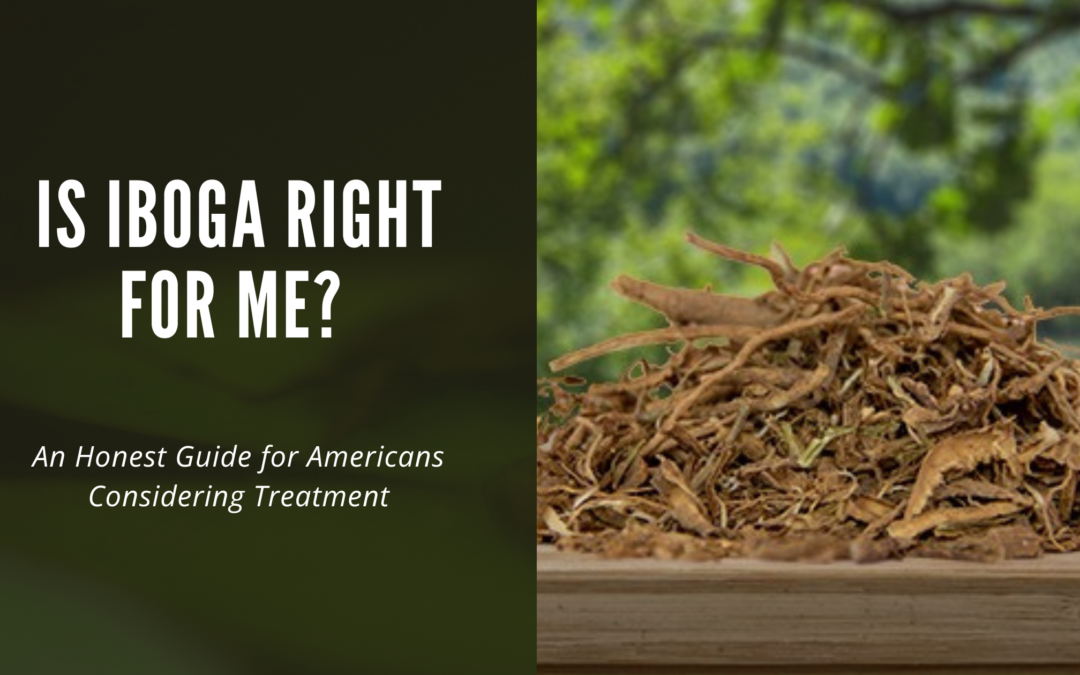
Is Iboga Right for Me? An Honest Guide for Americans Considering Treatment
By the Entheos Retreats Team | Entheos Retreats Iboga, Chiang Mai, Thailand
If you've found your way to this article, you're probably not casually curious about iboga.
You've likely been doing serious research, reading about ibogaine's effect on opioid receptors, watching documentaries, maybe quietly asking in forums whether anyone has actually done this. You want to know if it's real. And more personally: you want to know if it's right for you.
This is an honest answer to that question. Not a sales pitch or a list of miracle testimonials. A genuine framework for thinking through whether iboga is the right next step and whether now is the right time.
First: What Iboga Actually Is
Iboga is not just a detox program. It is not a substitute for medication. It is not a wellness retreat in any conventional sense.
Iboga is a sacred plant medicine from Central West Africa, used for centuries by the Bwiti people of Gabon as a rite of passage and a tool for deep healing.
Its primary alkaloid, ibogaine, has been studied for decades as one of the only substances known to virtually eliminate opioid withdrawal symptoms and dramatically interrupt addiction at a neurological level. Often in a single session.
But iboga is not simply pharmacology. The 18 to 30-hour experience it produces is one of the most profound and demanding inner journeys a person can undertake. It is a full life review. A confrontation with everything you have been avoiding. A direct encounter with the roots, not just the symptoms, of whatever has been driving your suffering.
This is why some people are changed by it permanently. And it is also why it is not for everyone.
Signs That Iboga May Be Right for You
You've tried other approaches and they haven't reached the root:
Suboxone, methadone, naltrexone, rehab, therapy, meetings, these tools have helped many people, and we respect them.
But for some, the cycle continues. The cravings return. The underlying pain that drove the addiction in the first place has never been addressed.
If you feel like you've been managing a symptom for years without ever reaching what's underneath it, iboga works differently. It goes to the source.
You want to understand why (not just stop):
Iboga doesn't just interrupt addiction chemically. It tends to show people, with unusual clarity and compassion, the experiences, wounds, and patterns that made the substance feel necessary in the first place.
Many participants describe seeing their entire history, their childhood, their relationships, their choices laid out with a kind of clear-eyed understanding they'd never had access to before.
If you want to understand yourself, not just get clean, this matters.
You feel called to go deep rather than manage:
There's a difference between wanting to stop using and wanting to genuinely transform.
Iboga is for the second. It is an intensive, demanding, revelatory experience, not a comfortable one.
If you feel a pull toward something that will actually change you at the level of who you are, rather than simply suppressing the behavior, that pull is worth paying attention to.
You're willing to do the preparation and the integration work:
Iboga is not a magic bullet you receive passively.
The weeks before your treatment you are getting medical screening, medication tapering, supplement protocol, and intention work. These are as important as the treatment itself.
And the weeks and months after, where the real-life work of integrating what you experienced begins, determine whether the opening becomes lasting change.
If you're willing to show up fully to the whole process, iboga can meet you there.
You're in a stable enough place to go in:
Paradoxically, iboga works best when you are not in acute crisis.
If you are in active withdrawal, medically unstable, or in the middle of an acute mental health episode, the immediate priority is stabilization first.
Iboga requires preparation time both logistically and physiologically.
The people who get the most from it come in as prepared as possible, not at rock bottom.
Signs That Iboga May Not Be Right for You... Right Now
We say this with care and without judgment: iboga is not the right tool for everyone, and honest guidance means saying so.
- If you have a cardiac condition, prolonged QT interval on EKG, severe liver disease, active epilepsy, or a history of psychosis or schizophrenia. Iboga carries serious medical contraindications. Full screening is required, and some conditions are absolute contraindications.
- If you are currently on methadone, you will need to transition to a shorter-acting opioid first. This is a process that takes time and requires medical support. It is absolutely doable, but it must be planned for.
- If you are on SSRIs or SNRIs, a washout period of 2 to 6 weeks is required before treatment can safely proceed. This is non-negotiable from a safety standpoint.
- If you are looking for something painless or easy iboga is not that. The experience is demanding. It will show you things you may have spent years not looking at. If you are not ready to be honest with yourself, this is not the right moment.
- If you are in active suicidal crisis, the immediate priority is crisis support. Iboga requires a stable enough foundation to do deep work safely. Please reach out to crisis services first.
None of these are permanent disqualifications as many are timing and preparation questions. But they matter, and we take them seriously.
The Question Underneath the Question
Most people who ask "is iboga right for me?" are really asking something deeper:
Is it possible for me to actually change? Have I gone too far? Is there something in me worth saving?
"The answer is yes. We have not yet met a person whose life could not change, only people who hadn't yet found the right door."
Iboga is a door. A demanding, serious, extraordinary door.
Not the only one. But for some people, particularly those dealing with opioid addiction or behavioral addiction who want more than management therapy, who feel the pull toward something real, it is the right one.
How to Know If You're Ready to Find Out
You don't have to be certain. You just have to be honest.
The best first step is a conversation with us. A genuine, no-pressure intake call where we talk through your history, your current situation, your goals, and your fears. We will tell you honestly whether we think iboga is a fit, whether the timing is right, and what preparation would look like for you specifically.
We are not in the business of convincing people to do this. We are in the business of doing it well, with people who are genuinely ready.
If you're reading this and something in you is saying yes, reach out.
The medicine will know if the time is right.